Options for ownership
Guest Blog by Prof Becky MalbY
We keep being asked what the solution is for how to run water in public ownership. Others propose solutions based on little real evidence about what works. This is what we know works and does not work….and therefore why public ownership is the answer
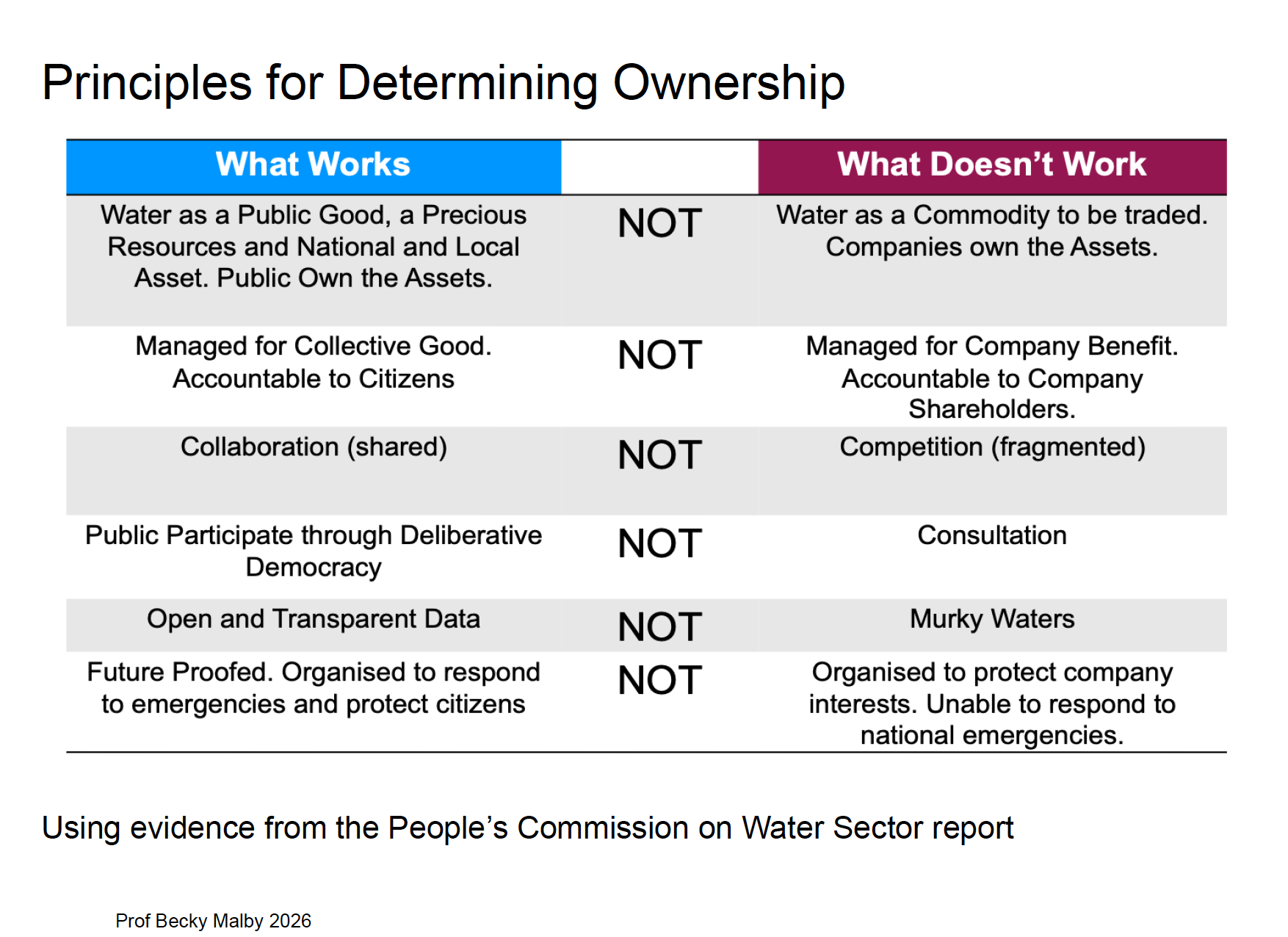
There are three options current in discussion - 1. propping up privatised water with one regulator persistently chasing pollution for profit 2. replacing each water company with a Mutual on the same footprint, keeping water as a commodity and paying off creditors 3. Public ownership with creditors taking a real haircut and water managed as a national asset, with full democratic decision-making. Despite multiple assertions that we can’t afford it the reality is public ownership is the cheapest options for the public. Here is why
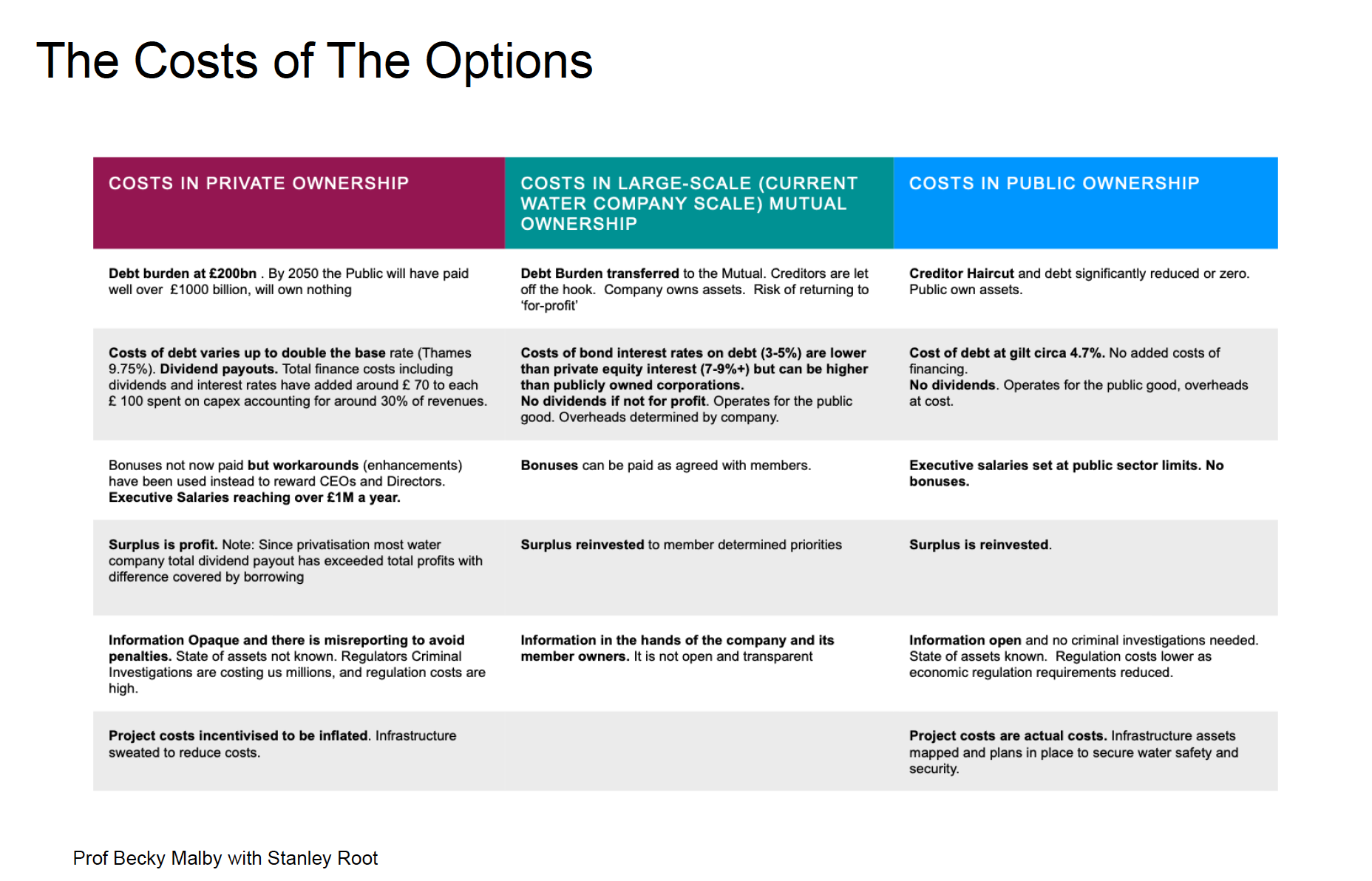
The driving force for redesigning our water system should be to secure the best model to secure a resilient sustainable water system to meet the demands of climate and population. That is public ownership.
The danger of compromise to accommodate the notion that all the costs must be kept ‘off book’ so as not to affect government borrowing, is that it does not secure us the best model to meet the crisis,
The obsession with keeping any debt off book’ is now the limiting factor to exploring the best model to meet the water crisis. Failure to do this will be much more expensive than any transition costs to public ownership.
It also fails to reflect the current direction of travel for fiscal rules away from measures that ignore the value of the assets. PSNFL needs to include assets as assets.
“…companies including Legal and General and Aviva warned the chancellor that herself imposed fiscal rules are making it harder and that public bodies should be allowed to borrow outside the fiscal rules in line with other European countries” Financial Times Feb 6th 2026.
Note when Network Rail failed as a mutual (cost too high, outcomes too poor) “The £31billion debt (equivalent to £44billion at current 2026 prices) became part of Public Sector Net Debt (PSND), but there was no discernible impact on government borrowing.” (Hall 2026)
The Chancellor can exclude public corporation borrowing from national debt figures – like every European country, and the UN systems of accounts – in our fiscal rules. He should. (McGaughey 2026).
The Chancellor amends the Charter of Budget Responsibility so that in calculating “Public Sector Net Financial Liabilities” it excludes “Public Corporations” that are market actors - same as the European System of Accounts, para 1.34 - and the UN standards.
What could public ownership look like structurally? Here is a ‘straw person’ suggestion. Its not the right answer but it shows that there are options available that have not even been considered. The Netherlands runs a water bank. Municipalised water is common in Europe. Mutuals can work at a small scale. The purpose of sharing this is to get government to be more ambitious and to learn from other countries.
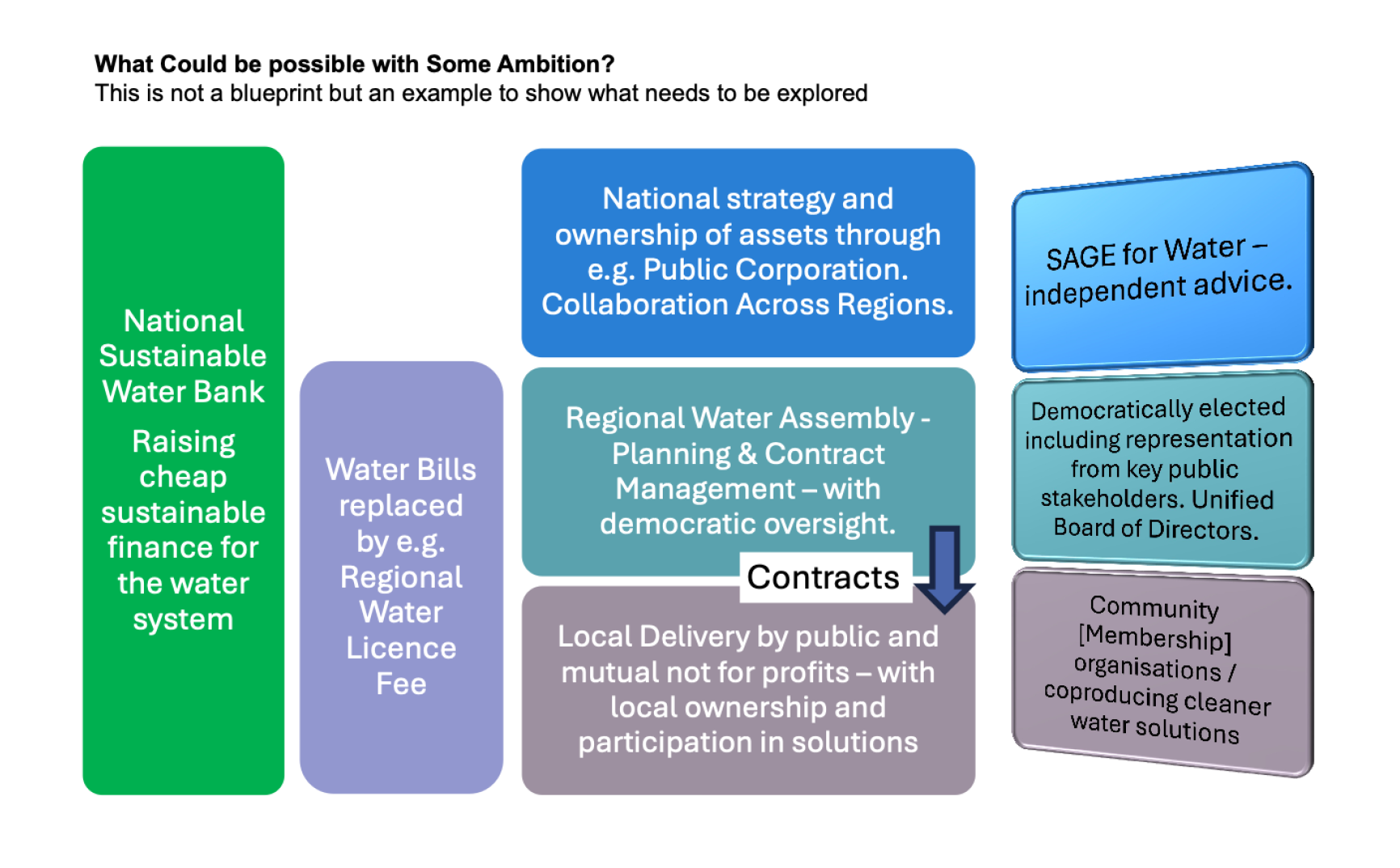
The government needs to be bold and take action that will ensure we can cope with impending water scarcity, and rampant pollution; delivering the best value with the public and putting our money to work to improving our water sector.