The Reality of Welsh Water
Guest Blog by Kim Waters, Welsh Rivers Union
Welsh Water is one of the examples being used to support the interest in converting private water companies into mutuals.
In this blog, Kim Waters from Welsh Rivers Union comments on the reality of having Welsh Water/Dwr Cymru (WW/DC) as the monopoly water and sewage services supplier, it turns out it is not a model to be copied.
Introduction
Dwr Cymru live under the radar in the UK water industry. Many myths and misinformation circulate about how they operate and are set up compared to their English counterparts. WW/DC do little to address the misinformation. As you will see in this blog, they may hold the crown as the worst water company in the UK.
Background
Welsh Water/ Dwr Cymru have the monopoly on delivering sewage and water services to 95% of Wales. They serve 3 million people, or 1.3 million customers. It is a private company set up as a Not-For Profit Company. Having no shareholders (only members- more on that later), it manages its investment cash flow by issuing bonds on the Luxembourg market as well as charging “water rates” to its client base. The company is wholly owned by its trading company Glas Cymru. It is regulated by both Ofwat and Natural Resources Wales, and its performance metrics are tied to Westminster law and Ofwat performance metrics. It is sometimes referred to as a “Mutual”, but it is not.
Performance
Dwr Cymru has demonstrated performance as one of the worst in the UK. Sourcing public information collated by sources (The Rivers Trust and Top of the Poops) they have consistently been in the worst performers for over 5 years. Here are the headlines:
Wales has 6 constituencies in the worst 10 for hours of raw sewage dumping via CSOs, including the worst 4.
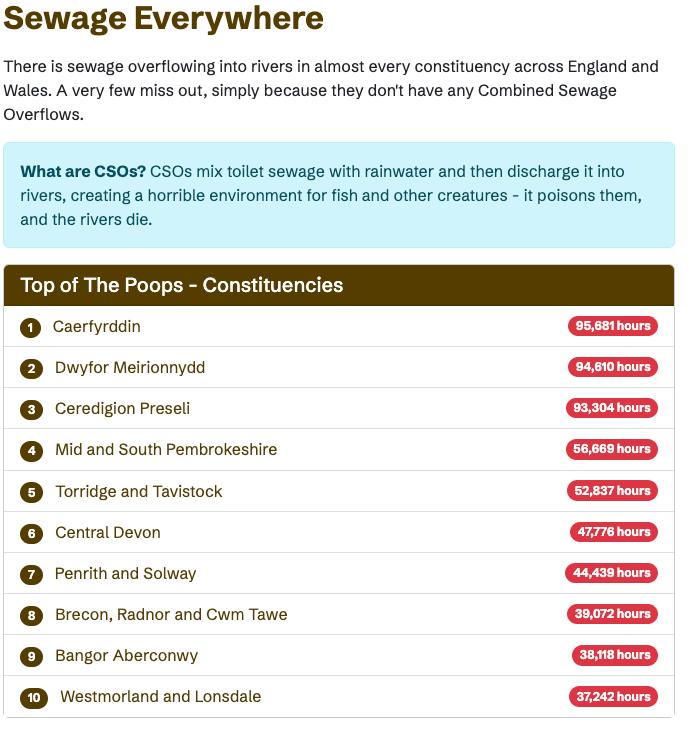
Dwr Cymru “manages” the single worst river in the UK for CSO hours dumping of raw sewage. The River Teifi has over 27 thousand hours.
Comparisons with other UK water companies show Dwr Cymru to be the worst. Dwr Cymru = Yellow.
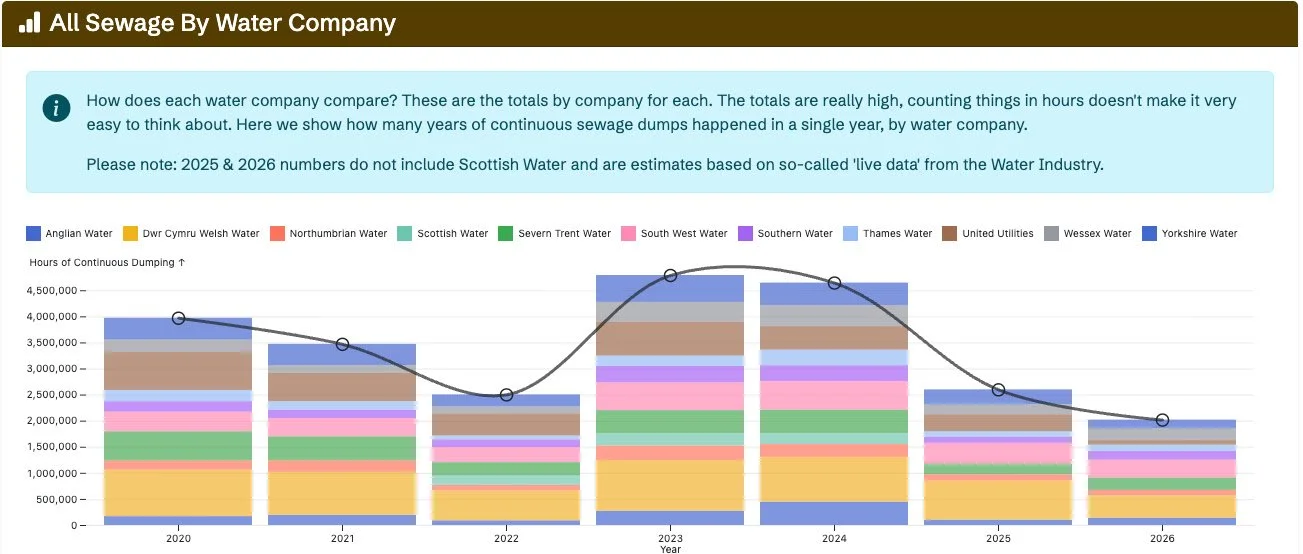
Top of the Poops https://top-of-the-poops.org/company/dwr-cymru-welsh-water
Leakages.
DC/WW don't come out well on the leakages front either. On current analysis, they have the equivalent of 94 Olympic-sized swimming pools of leakage every day, 365 days a year. Or put another way, 160 litres of water per customer per day. (Source: Nation.cymru)
Governance.
Of all the issues with Dwr Cymru, the company's governance concerns us most. As mentioned earlier, they seem to revel in the myths and misinformation propagated in the water industry world. They leverage their not-for-profit status to full effect, plastering it on their fleet of vehicles even though this isn’t strictly true. Plenty of overseas investors get their pound of flesh from the Welsh bill payer. They keep below the radar of Westminster, and the Welsh Senedd seem incapable of holding them to any serious scrutiny, often choosing charities to query DC/WW performance, charities that often accept funding from Welsh Water.
DC/WW proudly announce they have no shareholders but “members” (60 of them) who act like shareholders. Nothing could be further from the truth. The members are selected by the company executive, have no chairman, no record of their meetings, and no real power to veto anything or hold the executive accountable. The list of members reads like the usual suspects in Welsh society. Having spoken to quite a few of them, they confirm that it's rare for more than 20 to pitch up at any of the meetings, not votes are taken, and they are treated with contempt by the executive.
There have been some high-profile court cases recently. One key case saw Dwr Cymru brought to book for over 800 monitoring offences (2020/21) and charged on 15 counts, to which they admitted guilt.
During that same period, the top three executives earned £1.2M in bonuses beyond their inflated salaries.
One Final Point
They are not a mutual, more like a private members' club with all of the associated corrupt trappings.
Kim Waters, www.wru.org.uk