How to move to public ownership
Prof Becky Malby BEM FRCGP[Hon]
Prof Frances Cleaver, Dr Kate Bayliss
26th May 2026
Overview
This paper sets out the legal process for bringing water into public ownership, and the process by which the government could secure a modern bespoke public ownership model that learns the lessons from successful international systems. Privatisation in 1989 handed over considerable assets to water companies and promised long term investment to improve our water infrastructure. In reality our waters are polluted, much of our sewage is not treated, water infrastructure has been neglected, not maintained, whilst debt has reached extraordinary levels taking in some cases 1/3rd of households’ bill payments, and water owners have got rich on debt repayments and dividends. The scandal of water pollution and mismanagement at the expense of the public, and the environment have been exposed time and time again from docudramas (Dirty Business) to select committee reports (Efra 2025, PAC 2025). Whilst the biased Cunliffe Commission sought to represent the interests of ‘investors’ (Cunliffe spent over 40% of his time with investors) and water companies blaming regulation, setting the groundwork for the new Clean Water Bill, endless academic scrutiny shows that the cause of the water crisis is failed privatisation that cannot be remedied by regulation.
When it comes to examples of successful public water companies, we are spoilt for choice. There is a lot to learn from those countries that have transferred water into public ownership. But every case is different and England and Wales now have the opportunity to design a modern bespoke publicly owned water system, drawing on evidence from the rest of the world.
The arguments for public ownership have been made previously (The People’s Commission 2025) - setting out that under public ownership internationally water can be cleaner, cheaper and fairer. People understand that in public ownership all the money paid by the public goes into the water sector not to overseas shareholders, and that basic fact alongside disastrous outages of drinking water supply, drought orders and the continuous pollution of waters used by the British public drives public opinion. The majority believe that the security and sustainability of clean water is better served in public ownership.
This briefing does not yet again rehearse that evidence. Rather it sets out the pragmatic steps that pave the way for a resilient sustainable model of public ownership, making the most of the experience of countries that have gone before us. It is worth noting the international experience of water companies exerting strong lobbying pressure to delay or disrupt public ownership (e.g. in Berlin and Paris). The government has not been curious about why 90% of water internationally is in public ownership, and what works in various models
The government asserts that transition to public ownership would take too long and be too disruptive. However, once the decision has been made, the process need not be long – in Paris the transfer from private to public ownership was effected in 1.5 years (Le Strat 2025). Transition, if well planned provides the opportunity to undertake the preparedness required for an effective water system. There are well-documented European cases of the process of transition to public ownership (e.g. in France and Germany). Feasibility studies often precede transfer from private to public and are seen as critical to the effectiveness of the subsequent public ownership model. Information on costs are provided in Appendix 1.
We are therefore providing a step-by-step guide to the next 2 years to establish the very best conditions for effective and efficient public ownership of water.
Step One: The First Move to ‘Test the Water’.
Thames has failed. It has breached the terms of its licence and should be placed in SAR. Criticism of Special Administration come from lobbyists who fear spooking the bond market, and who purport that it will lead to extortionate costs neither of which are backed up by evidence. The creditors’ claims of costs at up to £4Bn have been thrown out in the High Court[1] and the Court of Appeal[2]. In fact the net costs to government of SAR are likely to be close to zero (Root and Malby 2026 – see Appendix 2).
It is crucial for the recovery of the water sector that Thames is put into Special Administration, to put a brake on the leak of bill payers' money to debt costs, to end the mismanagement of the company and to ensure transparency in company activities. It is also crucial for the future of the regulators ability to control the rest of the water sector. “There has to be a failure regime,” said Dieter Helm, professor of economic policy at Oxford University. “You cannot live in a world where there are no failures.” (Dunn, W 2026). Without SAR water companies know that no matter how bad it gets there are no real sanctions and the credibility of regulation is fundamentally undermined.
Putting Thames into Special Administration provides the opportunity for government to:
(a) Fully assess the state of the assets[3] and company performance. There is considerable evidence to indicate that the asset base is in a weak state. In 2024 Thames’ repair bill - the full cost of repairing all the company’s failing infrastructure - was estimated at £23bn. The KKR due diligence report (Plimmer and Smith 2025) (which cost Thames’ customers £20m) included the state of the assets but is not publicly available, (currently the subject of an FOI by the People’s Commission on Water). Thames water currently has £21bn debt.
(b) Secure a fair value of the company (the legal process in SAR) and any debt restructuring.
(c) Evaluate the best ownership option for Thames which can also form the basis for ownership models for other water companies
Moreover, SAR puts a moratorium on interest payments, meaning all bills can be used directly for maintaining assets.
SAR provides breathing space, a firebreak where the scale of the problem can be fully understood and a better solution can be designed. It also provides crucial intelligence from which to properly estimate the real state of water assets nationally, and the real costs of transition to public ownership.
A full explanation of the process and costs of SAR is attached in Appendix 2. The headlines are:
SAR does not cost the Treasury as all spend is recovered on exit from SAR.
SAR ensures that the water company comes out without debt immediately making up to 35% of money from water bills available for infrastructure. A massive injection of cash.
Any Treasury spend is recovered through the proceeds at the exit of SAR. If there is a funding shortfall the Secretary of State can recover funds shortfall from a water company (Water (Special Measures) Bill 2025) and ultimately from customers.
As part of the SAR process, debt will be restructured and debt service costs will reduce. Coming out of SAR, money allocated to servicing debt in the current model is immediately available for infrastructure (in the current model between 25 and 35% of all water company bills have been used to service historic debt), and any publicly owned water sector wanting to raise debt can do so at half the interest rate of current private sector borrowing which is currently circa 9-12% (10-year government bond – Gilts - rate is 4.9%). We provide more on the costs of public ownership in the Appendices.
SAR does not predicate public ownership as an exit strategy, but the government can set a Public Support Conditionality which ensures water companies exit SAR into public ownership (See Appendix 2). “Special Administration must not be a route to prepare for resale to the private sector. This would risk paving the way for a catastrophic repeat of the mistakes of past privatisation.” (People’s Commission 2025)
Other water company that are failing i.e. performance is clearly transgressing their license and they are also insolvent (currently these are Yorkshire Water, Southern Water, South West Water, Anglian Water), can then be taken into the SAR regime tried and tested with Thames Water if at this stage Step 4 below is not enacted. By now the temporary costs are clear and there is confidence in cost recovery. The process of transfer to public ownership is understood. The risk in this route is that it is not water-tight in terms of re-privatisation.
Meanwhile, with SAR now a viable option, government can use regulation to force the remaining privatised English Companies to meet their licence conditions. For example, this would include “Ofwat to require all other water companies to disclose independent audits of the estimated repair costs to fully comply with statutory principal duties for no sewage release without secondary treatment (a duty every water company is failing), and the duty to supply drinking without interruptions (as in SE Water). Importantly this is much more stringent than what Ofwat has allowed in its PR24 programme, e.g. 26% sewage reductions by 2030, instead of 100%” (McGaughey 2026).
McGaughey also suggests that Ofwat requires that repair costs are accounted for as a liability on the balance sheets of all companies. When such liabilities are fully disclosed, the balance sheets of water companies are going to be considerably weaker, possibly in breach of their licence conditions meaning that SAR can be applied.
Putting Thames into SAR gives the regulators more teeth to do the job to meet government commitments. That in itself buys time for proper preparedness for public ownership.
Step Two: Set the Direction and Work Out the Best Model to Deliver
With the Thames SAR process underway, the government should undertake Steps 2.
a) Strategy for Water & SAGE For Water
Without strategy there is no ambition or direction against which to determine the best delivery model. The current debate about ownership centres around costs, not around the long-term sustainability of our water supply, and how we conserve and protect water to ensure that people and ecosystems can thrive. Whilst the public debate focuses on water pollution, the strategy must bring us at least to the level of performance of other countries on water conservation and protection. For instance, non-revenue water (water lost to leaks) after 35 years of privatisation in England “is 4-5.5 times that of large Japanese cities, comparing abysmally to Tokyo and Osaka at less than 4%, Singapore at 5%, and Phnom Penh at 7.5%. In fact, many of the performance indicators of all the British water companies are significantly worse than Phnom Penh, a city that has less technical and administrative expertise and financial wherewithal” (Letter from Prof Asit Biswas 2025[4]).
The People’s Commission calls for the Strategy to be supported by a SAGE (Strategic Advisory Group of Experts) for Water (much like we had in the Covid crisis) to provide the independent advice needed by the government, away from the lobbying by invested interests.
b) Feasibility Study into What Sort of Public Ownership?
A feasibility study of public ownership models needs to examine the range of ownership models from public control to public ownership and should take no more than 6 months as the evidence is already available. This mimics the approach taken in Paris where the feasibility study underpinned their choice of public ownership model.
The Cunliffe Commission was not charged with and did not comprehensively report on ownership models to meet national requirements for an effective, efficient and sustainable water system. Quick fix solutions of ‘types’ of public ownership are being put forward, (determining the ‘form’ without knowing the ‘function’) without clarity on the best fit for our unique challenges from climate change and population and industry demand.
The People’s Commission on the Water Sector brought together international evidence and examples as a precursor to a more in-depth review which is required to design a modern bespoke public ownership model. It found that the commercialisation of water as a commodity rather than a vital resource, with the public as passive bill-payer was fundamentally problematic. Successful International strategies have removed commercialisation of water and brought in a democratic model with water assets publicly owned generating a significant financial value to the state. Some operate hybrid models, for example France operates a mixed model of delivery where ownership can be public, but delivery can be private/mutual/or public. The municipalities retain ownership of the infrastructure but provide 3 to 5-year contracts to delivery organisations which can be public, or private.
Mutuals have been provided as an example of public control, with very varying degrees of public contribution (see Welsh water as an example where the public has very little say, the company operates on commercial principles so that whilst bills are lower water quality is shocking) and decision-making, and a range of options for managing surpluses.
There are likely to be issues related to harmonisation of employment terms, IT systems, a shift from private to public accounting and a change of culture. The pragmatic measures and capacity building necessary to make the transition from private to public work have been documented in detail (Guerin-Schneider and Colon 2022). There are also international lessons on financing publicly owned water which should be explored as part of this study for instance the Netherlands Sustainable Water Bank (NWB)[5]
The feasibility study ensures that the model of consumerism and water as a commodity is not kept intact, or that any new ownership model copies anything that’s already broken. The study should provide intelligence to support a model of public ownership that sees water as a public good requiring strategy, collaborative planning at a regional level, ownership of the assets, active citizenship in a water conscious society, public and employee participation in governance, and a range of delivery organisations competitively contracted.
Public ownership can bring democracy back into the heart of decision-making about water and favours a decentralised regional model for managing delivery, with the assets on the public books, and a national strategy for water as the guiding principle for regional delivery.
The feasibility study will provide robust evidence on available options and create the basis for the design of a bespoke approach in England and Wales.
Step Three: Setting Up Infrastructure
Public ownership of infrastructure, and continued investment in infrastructure is a key factor of successful international schemes (Peoples Commission 2025). Once the ownership model is determined there should be phase of preparedness to ready the public for participating in their water system, the regional catchment type bodies for planning and oversight, and the financial mechanisms to ensure funding streams are maintained (for example the Netherlands established the Sustainable Water Bank for the public sector[6])
Step Four: Bringing Water into Public Ownership
Once the ownership model is clear, and the ground is prepared, water companies should be brought into newly designed bespoke modern public ownership through an Act of Parliament.
The government can pass a new Act of Parliament that authorises compulsory purchase of water companies. This new Act could include some of the ambitions of the current Clean Water Bill - addressing regulatory asymmetries, ensuring industrial users of water conserve and protect water - as well as ensuring that polluters pay (for instance pharmaceutical companies). The Bill can set the duties for the new publicly owned water organisations to secure clean water and to democratise governance and can set out how debt is treated. It can ensure that water companies before transition do not leak money or take dividends. It can also block any future privatisation.
Notes
[1] Re Thames Water Utilities Holdings Ltd [2025] EWHC 338 (Ch), Mr Justice Leech, 18 February 2025, paragraph 293. The judge rejected the Plan Company’s evidence that a SAR would cost between £3.35 billion and £4.01 billion: judiciary.uk
[2] Kington S.À.R.L. v Thames Water Utilities Holdings Ltd [2025] EWCA Civ 475, Sir Julian Flaux Chancellor, Lord Justice Zacaroli, Sir Nicholas Patten, 15 April 2025. The Court of Appeal confirmed the High Court’s rejection of the £3.35–£4.01 billion SAR cost claim and noted that the true direct government cost of equivalent bridging finance was quantified in evidence at £65.93 million.
[3] The Ofwat response to our FOI asking for the sections of the KKR Due Diligence report that relate to the state of the assets as currently this is not public information, was that they don’t hold the information. We have challenged that information.
[4] Asit K. Biswas Academician and Distinguished Visiting Professor, University of Glasgow, UK Director, Water Management International Pte Ltd, Singapore, Chief Executive, Third World Centre for Water Management, Mexico
[5] https://nwbbank.com/en
[6] https://nwbbank.com/en
References
Dunn, W (2026) Revealed: Thames Water’s environmental and financial disaster. New Statesman. February. Available at https://www.newstatesman.com/politics/uk-politics/2026/02/revealed-thames-waters-environmental-and-financial-disaster
Hall, D. and Gray, C. (2025). Leaking money. The finance costs of privatised water and regulation in England and Wales: Scottish public ownership shows potential savings, Working Paper. University of Greenwich. Available at https://gala.gre.ac.uk/id/eprint/50096/
Le Strat, A (2025) Presentation to the People’s Commission on the Water Sector. Available at https://www.thepeoplescommissiononthewatersector.co.uk/general-2-1
McGaughey E (2026) Public ownership of water: how to do it, costs and benefits
Ofwat (2024) PR 24 Final Determinations City Briefing. 19th December Available here https://www.ofwat.gov.uk/wp-content/uploads/2024/12/PR24-final-determinations-City-briefing.pdf
Malby, B., Cleaver, F. Bayliss, K., McGaughey E. (2025) The People’s Commission on the Water Sector: Cleaner, Cheaper, Fairer. Available at https://www.thepeoplescommissiononthewatersector.co.uk/reports
Peoples Commission (2026) The Government does not know the costs of public ownership. Blog. Available at
https://www.thepeoplescommissiononthewatersector.co.uk/blog/blog-post-title-one-8ma2e-sdats-c4epz
Peoples Commission (2026) Defra and the £100bn. Available at https://www.thepeoplescommissiononthewatersector.co.uk/blog/blog-post-title-three-fl8d3
Plimmer (2024 Two UK water companies lack complete maps of sewage networks
Financial Times, April 23rd. Available at https://www.ft.com/content/cdda3b65-ddd5-4db0-aaca-dc0b1a1f516b?syn-25a6b1a6=1
Plimmer G and Smith R ( 2025) Thames Water paid £20mn to cover KKR’s due diligence for abortive bid. Financial Times. October. Available at
https://www.ft.com/content/0d9c651d-0be1-43fb-bb21-236dea4a333f?syn-25a6b1a6=1
Root, S (2025) Evidence for the Independent Water Commission on Thames Water and Yorkshire Water. Reports available at https://www.thepeoplescommissiononthewatersector.co.uk/general-2-3
Root S and Malby R. (2026) Briefing on Special Administration for MPs and Peers. Sewage Campaign Network.
Sikka, P (2025) Public ownership is the only way to save the water industry. Left Foot Forward. Available at https://leftfootforward.org/2025/07/public-ownership-is-the-only-way-to-save-the-water-industry/
Windrush Against Sewage Pollution (WASP) (2025). It Pays to Cheat? WASP Blog. 21 April. Available at https://www.windrushwasp.org/single-post/it-pays-to-cheat
Appendix 1: The Costs
The Costs of Transition
The final costs of Special Administration could be close to zero.
The £100bn cost provided by Defra has been discredited and disproven. We conclude that the motivation for this £100bn valuation is to protect the status quo and eliminate discussion of policy alternatives, especially public ownership which is normal in the rest of the world. (Peoples Commission Blog 2026) The idea that NHS and Education budgets would be affected is clearly scaremongering and false. We are currently financing the sector through water bills and this would continue so impact on the taxpayer would just be in the form of the transactions costs of the ownership transition.
“I asked bankers and hedge fund managers who invest in gilts how their trading of British government debt would change in the extreme scenario that Thames Water’s debts were nationalised and transferred to the public balance sheet in full. The consensus, summed up by one investor, was that even an extra £17bn would be “trivial” in comparison to the UK’s wider debts. “I doubt we would see any significant rise in gilt yields,” the person told me.” Dunn (2026)[8]
The Costs/ Benefits of Public Ownership
The Costs of Private Ownership
We know costs of the private water sector:
Ofwat has allocated £22Bn in this current 5-year price review period (PR24) as maximum ‘returns on capital’. That is the costs of financing privatisation until 2030. This has doubled from the last price review. This is the first cost of privatisation that would be reduced by public ownership. Even if money has to be borrowed (and this will be minimal see below) it will be at half the interest rate (4.9% gilts) being paid currently (9-12%).
By 2050 customers will pay £600bn for 25 years of privatisation. This is in addition to annual bills set to rise year on year to well over 350bn. The public will have paid over £1000bn and own nothing but owing billions in debt. (Sikka 2025)
There is evidence to indicate that companies inflate the costs of investment projects Currently the pricing value of water companies is linked to the spend on capital which incentivises inflated capital costs. We have evidence that the costs of water company business plans in the current model are inflated (WASP 2025). Capital project costs in the UK appear to be much higher than costs in Europe.
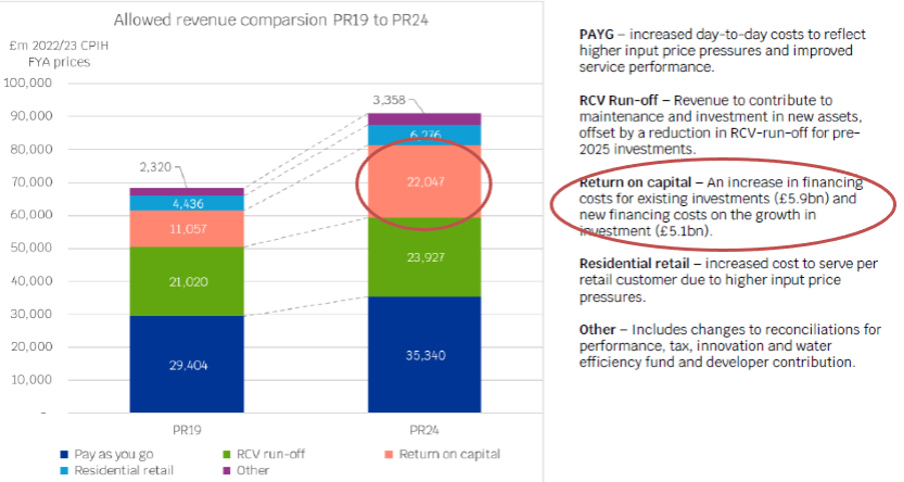
(Ofwat 2024)
The Costs of Public Ownership
Despite claims of high costs. government does not know the cost of public ownership. An FOI request asking for Defra’s figures on the ongoing costs of public versus private ownership over 30 years secured this response:
“the government has no intention to nationalise and therefore has not assessed the ongoing costs of continuing with the current privatised model versus public ownership of the water industry”. Peoples Commission 2026 p44
But we do know that public ownership could be cheaper than private ownership and this is why:
Surplus funds would be reinvested. Under a public water system, surplus funds can be reinvested thereby reducing costs and promoting social equity. There are no dividend payouts.
Cheaper debt. Any debt required is raised by public bodies at lower cost (close to the Bank of England base rate, currently 4.5% p.a.) than commercial borrowing (Thames Water’s latest loan cost 9.75% p.a.).
Costs of regulation fall as information is open and transparent, rather than hidden requiring investigations. There is no need for costly criminal investigations.
Inflated financing costs disappear. Hall and Gray (2025) calculate that on average 35% of company revenue from bills in 2023/24 went in financing costs, a figure supported by Root (2025).“Taking the English and Welsh water companies into public ownership could save £3bn-£5bn in annual financing costs. This could increase new investment, or reduce the average annual water bill by £100-£160 per annum.” Hall & Grey (2025)
There are no incentives to inflate project costs. Projects will be cheaper.
“If Thames Water had been in public ownership, it would not have paid £10.4bn in dividends. Instead of paying £13.68bn in interest payments, it would have paid less than half. It would not be paying £200m a year to lawyers, bankers, accountants and sundry advisers for advice on financial engineering and staving off bankruptcy. These measures alone would have generated billions for investment. Lower water bills under public ownership would mean lower household and business costs, inflation rates and poverty.” Lord Sikka 2026
The total reduction in costs could provide more funding to address the failings of the water companies to maintain the assets they inherited
But importantly water quality could be better in public ownership as free from the profit imperative, public sector water utilities can focus primarily on the public good. Fifteen years after re-municipalisation Paris is securing high quality water at a fair price; users are at the heart of the service; there is equal access to drinking water for everyone; there is transparent management of the resource and Paris now has a long-term vision of the service (Le Strat 2025)